

Spray Foam Inspections After a Hurricane: What Louisiana Insurers Want to See
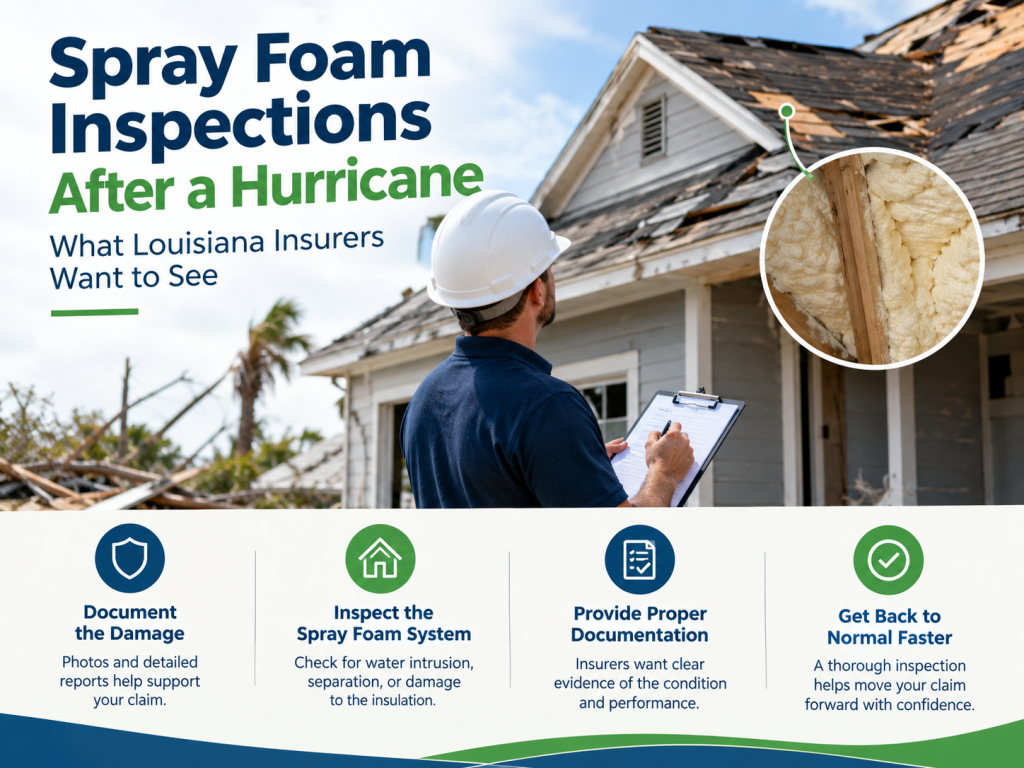
A claim is a documentation exercise. The damage is real either way; what decides how the process goes is what you can show, when you showed it, and whether the record was made before anything was touched.
Spray foam complicates that in one specific way. Foam applied under a roof deck sits between you and the sheathing, so wind-driven water can wet the deck without producing a stain on a ceiling. A house can look untouched from inside while the assembly above the foam has taken water. That is worth understanding before storm season rather than during it.
This page is about documentation practice and Louisiana’s claim process. It is not legal or insurance advice, and nothing here determines whether a particular loss is covered. Coverage depends on your policy’s terms, exclusions, limits, deductibles and the cause of loss, and those questions belong with your insurer, your adjuster or a qualified professional.
What the Louisiana Department of Insurance tells policyholders to do
The department’s Post-Disaster Insurance Guide is specific, and the instructions are worth following exactly.
- Report the claim promptly. Call your insurance producer or the company’s claims hotline as soon as possible, with your policy number to hand. Your policy might require notification within a certain time frame. Keep a record of every call, including the person’s name, title, date and time, and notes on what was discussed.
- Photograph and video everything. The guide states that taking photos and videos of your property is the best way to document damages for your insurance company.
- Make temporary repairs, not permanent ones. Make temporary repairs to prevent further losses and to secure the property, such as boarding up windows, placing plastic over holes in the roof, and drying out wet carpets and furniture.
- Keep receipts. Keep receipts for materials used and keep a record of the repairs you make for the adjuster.
- Wait for authorization before permanent work. Do not make permanent repairs until you are authorised to do so by the adjuster.
- Build the inventory. A current list of what is in your home speeds up the process. The National Association of Insurance Commissioners publishes a free home inventory app.
That fifth point is the one that trips people up with insulation. Tearing out foam before the adjuster has seen it removes the evidence and may be treated as a permanent repair. Photograph it, protect it from further water, and ask before you remove anything.
The deadlines that apply in Louisiana
Three statutory timeframes are worth knowing, because they tell you when to expect movement. Which of them applies turns on whether your loss is a catastrophic loss, so start there.
Under La. R.S. 22:1892, except in the case of catastrophic loss, an insurer shall initiate loss adjustment of a property damage claim within fourteen days after notification of loss by the claimant. For catastrophic losses, adjustment must be initiated within thirty days after notification, and the commissioner may promulgate a rule extending that period by up to an additional thirty days.
The same statute provides that insurers shall pay the amount of any claim due any insured within thirty days after receipt of satisfactory proofs of loss, and shall make a written offer to settle a property damage claim within the applicable number of days after receipt of satisfactory proofs of loss. The Louisiana Department of Insurance states that same thirty-day rule in plain terms in its consumer guide.
After a hurricane, though, a different payment clock is likely to be the one that matters. Louisiana defines a catastrophic loss as a loss that arose from a natural disaster, windstorm, or significant weather-related event that was a presidentially declared emergency or disaster or a gubernatorially declared emergency or disaster. For catastrophic losses, La. R.S. 22:1892.2 sets separate payment periods:
| Situation | Payment period after satisfactory written proof of loss |
|---|---|
| Claim governed by La. R.S. 22:1892 generally | 30 days |
| Catastrophic loss under a policy for residential property | 60 days |
| Catastrophic loss under a policy for immovable property other than residential | 90 days, extendable by up to 30 more by the commissioner for commercial policies insuring multiple locations |
So if a named storm produced a declared emergency and your home is the insured property, the figure to work from is generally sixty days rather than thirty. Ask your insurer in writing which statute and which clock they are applying to your claim.
The phrase that does the work in all three rows is satisfactory proof of loss. The clock on payment starts from that point, which is a practical reason to make your documentation complete and early rather than partial and incremental.
Your hurricane deductible is probably not your normal deductible
The Louisiana Department of Insurance flags this as one of the key pieces of information to know in advance: whether your homeowners policy carries a hurricane, named-storm or wind and hail deductible alongside the basic all-peril deductible. The two can work differently from each other, so read the declarations page rather than assuming a single figure covers everything.
The department also notes a detail that matters if you are hit twice in one season. If a claim falls below your deductible and you pay the whole cost yourself, document the damage with photographs and keep the receipts, because that spending can count toward the next deductible if a second storm damages the property during the same storm season.
Wind and flood are usually separate policies with separate adjusters. The department’s guidance is that you may need to file with each policy you hold and let the adjusters determine which policy covers which part of the loss. Do not decide for yourself that something is not covered and skip filing.
Where a spray foam inspection fits
An inspection report is evidence you hand to an adjuster. It does not decide coverage, and any company that tells you its report will get a claim paid is overselling.
What a post-storm foam inspection can put on the record:
- Dated photographs of the assembly in its post-storm condition, taken before any remediation.
- Debonding. Foam that has separated from the roof deck or framing, with the location and extent recorded. Adhesion is one of the clearest indicators that something changed.
- Water staining at the foam edges, at penetrations and at the eaves, where water that got past the roof covering tends to show first.
- Moisture readings in accessible framing and sheathing. Numbers are more useful than adjectives. The traditional guideline for protecting wood from rot or decay is to keep moisture content below 20 percent; mould growth can occur on wood above roughly 15 to 18 percent, and corrosion of fasteners in treated wood above roughly 18 to 20 percent. Time spent at an elevated level matters in each case.
- Rust on nails, nail plates and connectors, which can indicate sustained wetting rather than a single event.
- Displacement or compression of foam near the ridge, the eaves or around penetrations.
- The product and specification, taken from the State of Louisiana Insulation Certificate, which is required to be permanently posted in a utility area and records the foam type, density, installed thickness, the installer and the contractor license number.
That last item is quietly valuable. A claim involving insulation is easier to discuss when the pre-loss specification is documented rather than described from memory.
An order of operations that keeps your options open
- Make the property safe and make temporary repairs only. Board up, cover holes, stop further water.
- Photograph and film before anything is moved, including the attic and any accessible under-floor area.
- Report the claim and record who you spoke to and when.
- Get the foam and the assembly documented while the condition is still the post-storm condition.
- Keep every receipt for temporary repairs and materials.
- Wait for the adjuster’s authorisation before permanent repair or removal.
- Keep mould work separate and licensed. In Louisiana, mould remediation valued at $7,500 or more requires a Mold Remediation license, and the qualifying party must hold twenty-four hours of training in mould remediation and basic mould assessment.
- Escalate if you need to. The Louisiana Department of Insurance takes consumer questions and complaints on 1-800-259-5300.
Being careful about contractors after a storm
The department’s own guidance is blunt about this, and it is worth repeating because storm chasing is a real pattern on this coast. Most of the time an insurance company does not recommend a contractor, so be wary of anyone who claims the insurance company sent them. Always ask to see something in writing, get more than one bid, hire a reputable local contractor and do not pay for repairs until the job is done.
License status is checkable in a few minutes, and after a storm it is worth the few minutes. The Louisiana State Licensing Board for Contractors runs a free contractor search. Search the exact legal entity name on the contract, then read the status, the classifications and the expiration date off the result.
Before the next storm
Two things are worth doing while the weather is fine.
Photograph the attic now. A dated set of photographs of the foam in good condition, plus a copy of the insulation certificate, gives you a before to set against any after. Documentation created before a loss is harder to argue with than documentation created during one.
Find out what your policy actually says about your hurricane deductible, about roof coverage and about any conditions attached to the insulation or the roof covering. Read the policy rather than the summary page, and ask your agent for anything that is unclear.
If you want the attic condition recorded properly, that is what spray foam inspections are for. If the storm exposed a roof problem, white roof coatings and attic insulation are the two service pages most people move on to.
Frequently asked questions
Will my homeowners policy cover wet spray foam insulation?
That depends on the policy and on the cause of loss, and no inspection report changes that. Wind-driven rain entering through a storm-damaged roof and rising floodwater are different perils, commonly handled by different policies with different terms. What documentation does is establish what the condition is and when it was recorded. Coverage is a question for your insurer and your adjuster, subject to your policy terms.
Should I remove wet foam before the adjuster arrives?
Not unless you are told to. Louisiana Department of Insurance guidance is to make temporary repairs that prevent further damage and to hold off on permanent repairs until the adjuster authorises them. Removing insulation is likely to be treated as permanent work, and it destroys the evidence. Photograph it, prevent further water reaching it, and ask.
How do I know if water got in above the foam?
You often cannot tell from the room below, which is the point of this article. The signs that are visible from inside an attic are staining at the edges of the foam, debonded sections, rust on fasteners and connectors, and a musty smell. Moisture meter readings on accessible framing give you numbers rather than impressions. Where foam fully covers the deck, some of the assessment is inference from the evidence at the edges.
How long does my insurer have to respond in Louisiana?
Under La. R.S. 22:1892, an insurer must initiate loss adjustment of a property damage claim within fourteen days after notification of loss, except in the case of catastrophic loss, where it is thirty days after notification, with the possibility of the commissioner extending that by up to a further thirty days. Payment deadlines depend on the type of loss. The general period under that statute is thirty days after receipt of satisfactory proofs of loss. For a catastrophic loss under a policy for residential property, La. R.S. 22:1892.2 provides sixty days after receipt of satisfactory written proof of loss, and ninety days for immovable property other than residential. Your own policy may add requirements on your side, so read it.
Does having spray foam affect my insurance premium?
We cannot tell you, because rating factors and credits vary by insurer and by programme and they change over time. Ask your agent directly what your policy recognises, get the answer in writing, and put the same question to any insurer you are quoting against.
Can an inspection report on its own get my claim paid?
No. A report is evidence that supports a claim; the decision rests with the insurer under the policy. What a good report does is make your position specific and dated, with photographs, locations and measurements rather than descriptions. That tends to make the conversation with an adjuster shorter, which is worth something on its own.
Get the condition on the record
Star Spray Foam is based in New Orleans at the address below. Ask whether your address is inside the working area when you call. If you need the attic documented, whether ahead of storm season or after a loss, get in touch and ask what the inspection covers, what the report contains and how quickly it can be scheduled.
Star Spray Foam
5826 Louis XIV St, New Orleans, LA 70124
504-229-6500
Sources
- Louisiana Department of Insurance, Post-Disaster Insurance Guide: https://www.ldi.la.gov/docs/default-source/documents/publicaffairs/consumerpublications/post-disaster-guide.pdf?sfvrsn=9
- La. R.S. 22:1892, payment and adjustment of claims, subsections A(1), A(3) and A(4), and the definition of catastrophic loss at B(1)(c)(i), via FindLaw: https://codes.findlaw.com/la/revised-statutes/la-rev-stat-tit-22-sect-1892/
- La. R.S. 22:1892.2, catastrophic loss claims settlement practices, subsections A(2) and A(3), via FindLaw: https://codes.findlaw.com/la/revised-statutes/la-rev-stat-tit-22-sect-1892-2/
- Louisiana Energy Code 2021, Section R401.3 Certificate, via UpCodes: https://up.codes/viewer/louisiana/iecc-2021/chapter/RE_4/re-residential-energy-efficiency
- LSU AgCenter Pub. 3187, Insulating Raised Floors in Hot, Humid Climates, with the USDA Forest Products Laboratory, for wood moisture content thresholds: https://www.lsuagcenter.com/nr/rdonlyres/d33f711d-dc4b-4e4c-9ed6-a97dce9db026/79805/pub3187insulatingraisedfloorslowres.pdf
- Louisiana State Licensing Board for Contractors, Types of Licenses, including the Mold Remediation license threshold: https://lslbc.gov/types-of-licenses/
- Louisiana State Licensing Board for Contractors, contractor search by name: https://arlspublic.lslbc.louisiana.gov/Public/DetailedSearch/ByName


