

What ACH50 Should a New Orleans Home Hit?
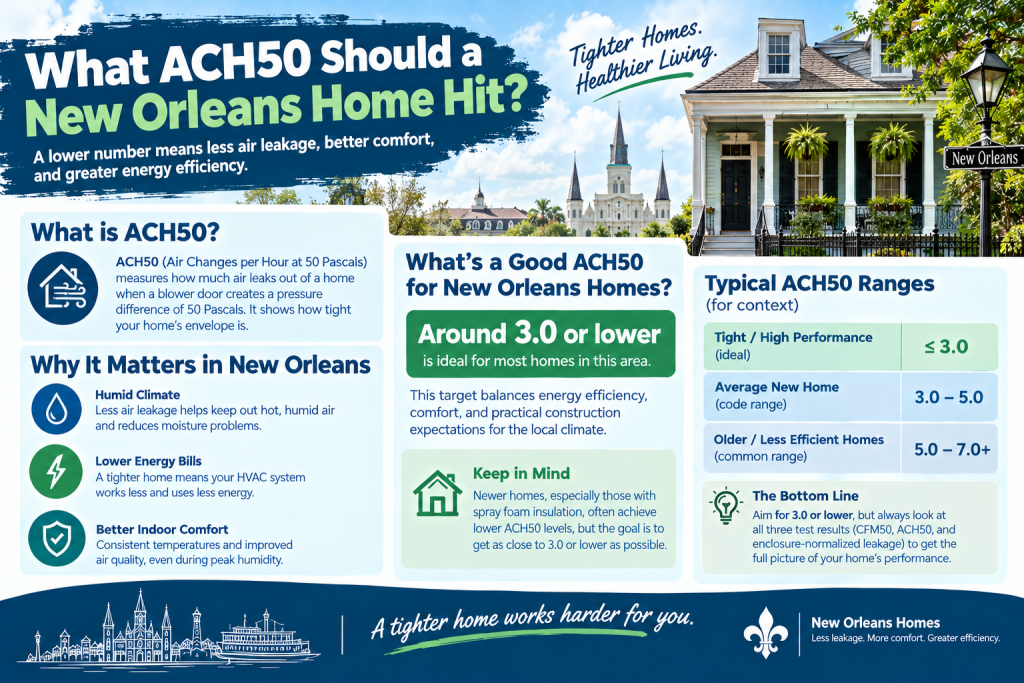
If you have been handed a blower door result, you are looking at a single number and wondering whether it is good. The honest answer has two halves. There is the number Louisiana law holds your house to, and there is the number that actually makes a house comfortable in a swamp climate. They are not the same number, and most national blog posts get the Louisiana half wrong.
Here is what the figure means, what the state code actually requires, and what to do if your house came in high.
What ACH50 actually measures
ACH50 is short for air changes per hour at 50 pascals. A calibrated fan is sealed into an exterior doorway and run until the pressure inside the house is 50 pascals below the pressure outside. The industry’s standard way of describing that pressure is a rough analogy: it is about what a 20 mph wind would exert if it hit every wall of the house at once. Treat it as a mental picture rather than a precise conversion, since real wind pressure depends on exposure, orientation and air density.
The fan then reports how much air it has to move to hold that pressure. Software converts that airflow into a count of how many times the entire volume of air inside the house is replaced in an hour under those conditions.
So a house at 7.0 ACH50 is swapping its full internal air volume seven times an hour while the fan is running. The real world is not a permanent 20 mph wind, so this is a comparison yardstick rather than a description of a typical Tuesday. Lower is tighter.
The number Louisiana holds you to: 7.0 ACH50
This is where the local answer separates from the national one.
The Louisiana Energy Code 2021 is based on the 2021 International Energy Conservation Code, and it took effect statewide on 1 July 2023. Louisiana amended the air leakage section. As adopted in this state, the maximum air leakage rate for any building or dwelling unit under any compliance path shall not exceed 7.0 air changes per hour, or 0.28 cubic feet per minute per square foot of dwelling unit enclosure area.
The national model code that most online guides quote is stricter. The base 2021 IECC sets 5.0 ACH50 for climate zones 1 and 2, and 3.0 ACH50 for zones 3 through 8. Louisiana did not adopt the 5.0 figure.
| Standard | Air leakage limit that applies |
|---|---|
| Louisiana Energy Code 2021, as adopted | 7.0 ACH50, or 0.28 cfm per sq ft of enclosure |
| Base 2021 IECC, climate zones 1 and 2 | 5.0 ACH50 |
| Base 2021 IECC, climate zones 3 to 8 | 3.0 ACH50 |
There is also an allowance in the Louisiana text for smaller and attached homes. An air leakage rate not exceeding 0.30 cubic feet per minute per square foot of enclosure area is permitted in all climate zones for attached single and multiple family dwelling units, and for buildings that are 1,500 square feet or smaller.
If a builder, inspector or rater quotes you 5.0 ACH50 in Louisiana, they are quoting the model code rather than the version the state adopted. Ask which document they are working from. Our companion guide covers what Louisiana’s code actually requires, including who is allowed to run the test and the other amendments the state made.
Passing the code is a floor, not a goal
A house at 6.9 ACH50 passes in Louisiana. That does not make it a comfortable house.
Air leakage is how humid outdoor air gets into a New Orleans home. Every cubic foot of August air that leaks in arrives carrying moisture, and your air conditioner has to strip that moisture out before the house feels cool. That is latent load, and it is the reason a house can hit its thermostat setpoint and still feel clammy.
The tighter the envelope, the less outdoor moisture the equipment has to fight. That is the practical argument for treating 7.0 as a floor and building tighter than it. Tightening also carries an obligation, and Louisiana wrote the trigger into the code. Effective 1 July 2024, where a blower door test is performed and the air infiltration rate of a dwelling unit is less than 3 air changes per hour, the dwelling unit must be provided with whole-house mechanical ventilation in accordance with Section M1507.3.
That is a genuinely important number for anyone considering spray foam, because foam is very capable of taking a house below 3 ACH50. Ventilation then has to be designed in rather than added as an afterthought. Have that conversation before the foam goes in.
The other way to pass: cfm per square foot
The two ways of expressing the limit exist because ACH50 penalises small houses. A shotgun double and a 4,000 square foot new build can have the same quality of air sealing and land on very different ACH50 numbers, because ACH50 divides by internal volume.
The cfm per square foot of enclosure area metric divides by surface area instead, which is closer to where the leaks actually are. For a compact New Orleans home, the cfm per square foot path is often the fairer test. Ask your rater to report both.
How the test is run
Louisiana’s code names the test methods: ANSI/RESNET/ICC 380, ASTM E779 or ASTM E1827, with the result reported at a pressure of 0.2 inch water gauge, which is the same thing as 50 pascals.
On a typical visit, the sequence looks like this:
- Exterior doors and windows get closed, and interior doors get opened so the whole house reads as one volume.
- Combustion appliances are handled per the standard so nothing is backdrafted during the test.
- The fan and frame are sealed into one exterior doorway.
- The fan runs, the house is brought to the test pressure, and the airflow is recorded.
- When the visit is diagnostic, the fan stays running while a technician walks the house with a smoke pencil or an infrared camera to find where the air is coming in.
Setup takes longer than the measurement itself. The diagnostic walk is the part worth paying for, because a certification number alone tells you that you have a problem without telling you where it is.
Who is allowed to run the test in Louisiana
The state added a credentialing requirement. Effective 1 July 2024, blower door testing must be performed by individuals certified to perform blower door tests by a nationally recognized organization that trains and provides certification exams for the procedure.
If you are buying a test for a permit, confirm the tester holds a current certification from a recognised body before you book. A result from an uncertified operator can be rejected.
What a New Orleans house does to your number
Local construction gives the fan plenty to find. The recurring leak paths in this housing stock are built into how the houses were put together:
- Raised pier and beam floors. An open crawl space means the floor system is an exterior surface, and every penetration through it is a direct path to outside air.
- Balloon framed walls in older homes, where the wall cavity runs uninterrupted from the crawl space to the attic and behaves like a chimney.
- Attic knee walls in storey and a half houses, where a vertical wall faces directly into an unconditioned attic and is often insulated without any air barrier behind it.
- Unsealed chases for plumbing stacks, flues and wiring, which connect the crawl space to the attic through the middle of the house.
- Recessed lighting and attic hatches, which puncture the ceiling plane where hot air wants to escape.
These are also the reason the stack effect is so pronounced in local homes. Warm air rises out of the top of the house and pulls replacement air in from the crawl space below.
What to do if the number comes back high
A high result is a starting point rather than a verdict. The order of operations that gets the most improvement per dollar usually runs:
- Seal the big holes first. Chases, dropped soffits, attic hatches and rim joists move far more air than the gaps around a window.
- Establish one continuous air barrier. The barrier has to be a closed surface. An air barrier with a hole in it performs like the hole.
- Then insulate. Fibrous insulation slows heat but does not stop air, which is why attic insulation laid over a leaky ceiling underperforms its label.
- Re-test. The only way to know the work moved the number is to run the fan again afterwards.
Spray foam is often the tool for step 2 and step 3 at once, because it forms the air barrier and the thermal layer in a single application. Whether open cell or closed cell is the right call depends on the assembly, and the differences are covered in our guide to open cell versus closed cell insulation.
If you want the diagnostic before committing to any work, that is what blower door testing and a full energy audit are for.
Frequently asked questions
Is 7.0 ACH50 a good result for a New Orleans home?
It is a passing result under the Louisiana Energy Code 2021, which sets the limit at 7.0 air changes per hour or 0.28 cubic feet per minute per square foot of enclosure area, whichever basis the dwelling is assessed on. Passing and performing are different standards. A house that sits right at the limit is still pulling a lot of humid outdoor air through its envelope in August, and that moisture load lands on your air conditioner. Treat 7.0 as the line you must clear rather than the target you aim for.
Does my existing home have to meet the 7.0 ACH50 limit?
The limit is a construction requirement, enforced through the permit process on new residential work, so an existing house that has never been tested is not in breach of anything. The figure is still the most useful yardstick available to you, because it shows how your house compares with what the state accepts for a new build. Whether the requirement attaches to a particular renovation or addition is a question for the parish permit office reviewing your plans.
What is the difference between ACH50 and CFM50?
CFM50 is the raw airflow the fan has to move to hold the house at 50 pascals, measured in cubic feet per minute. ACH50 takes that airflow and divides it by the volume of air inside the house to express it as air changes per hour. CFM50 describes the leak. ACH50 describes the leak relative to the size of the house, which is why two homes with identical CFM50 readings can have very different ACH50 scores.
Can I do a blower door test myself?
Not in any way that counts. The equipment is a calibrated fan with a manometer, and the result depends on following ANSI/RESNET/ICC 380, ASTM E779 or ASTM E1827 exactly. For any test tied to a permit in Louisiana, the work must be done by someone certified by a nationally recognised organisation, a requirement that took effect on 1 July 2024. You can find drafts yourself on a windy day with an incense stick, but that is a hunt for leaks rather than a measurement.
Will spray foam on its own get my house under the limit?
Often, though not automatically. Spray foam forms an air barrier where it is applied, so it does real work on the number when it lands on the right surface. It does nothing about leak paths it never touches, such as an unsealed plumbing chase, a dropped soffit or a leaky duct system running through an unconditioned attic. The reliable sequence is to test first, seal the large bypasses, apply the foam, then re-test to confirm.
Does the test damage anything or make a mess?
No. The fan sits in a frame inside a doorway, and the house is depressurised gently. The main preparations are closing exterior openings, opening interior doors, and dealing with combustion appliances and ash in fireplaces so nothing gets drawn into the living space. Nothing is drilled, cut or removed.
Get the number for your own house
Star Spray Foam works on homes across New Orleans. If you want the measurement before anyone quotes you for work, get in touch and ask for a blower door test.
Star Spray Foam
5826 Louis XIV St, New Orleans, LA 70124
504-229-6500
Sources
- Louisiana Energy Code 2021, Chapter 4 [RE] Residential Energy Efficiency, Section R402.4.1.2 Testing, via UpCodes: https://up.codes/viewer/louisiana/iecc-2021/chapter/RE_4/re-residential-energy-efficiency
- Louisiana Residential Code 2021, Chapter 11 [RE] Energy Efficiency, via UpCodes: https://up.codes/viewer/louisiana/irc-2021/chapter/11/re-energy-efficiency
- North American Insulation Manufacturers Association / Insulation Institute, Louisiana Residential Building Code update: https://insulationinstitute.org/wp-content/uploads/2024/03/LA_Code_2023_v2.pdf
- Base 2021 IECC air leakage thresholds, PNNL 2021 IECC determination analysis: https://www.energycodes.gov/sites/default/files/2021-07/2021_IECC_Final_Determination_AnalysisTSD.pdf
- Louisiana HB 803 statewide code adoption and 1 July 2023 effective date, International Code Council: https://www.iccsafe.org/about/periodicals-and-newsroom/louisiana-clears-new-bill-to-improve-energy-efficiency-codes-statewide/
- The 50 pascal to 20 mph wind analogy as commonly used in the trade, InterNACHI: https://www.nachi.org/blower-door-test.htm


