

Does Louisiana Building Code Require a Blower Door Test?
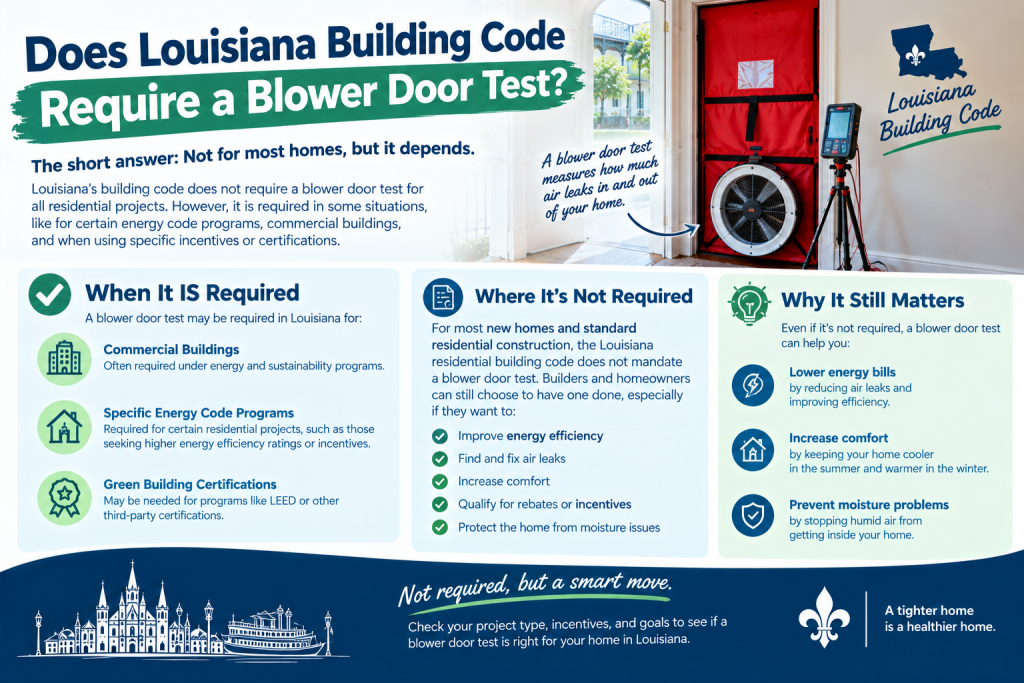
Yes. Louisiana’s residential energy code sets a maximum air leakage rate that has to be demonstrated by testing, and since 1 July 2024 the person running that test has to hold a recognised certification.
The detail matters more than the yes, because Louisiana amended the national code when it adopted it. Builders working from a national spec sheet, or from a checklist their supplier printed in another state, routinely quote the wrong numbers here. Below is what the version in force in Louisiana actually says.
Which code applies, and since when
Louisiana adopted the 2021 editions of the International Energy Conservation Code and the International Residential Code Chapter 11 through HB 803, signed in June 2022. The statewide effective date was 1 July 2023. The same law created a 16 member Energy Code Commission with authority to review and amend those provisions, which is where the Louisiana-specific figures come from.
Low-rise residential buildings of three storeys or fewer fall under the residential provisions.
The number you have to hit: 7.0 ACH50
As adopted in Louisiana, the maximum air leakage rate for any building or dwelling unit under any compliance path shall not exceed 7.0 air changes per hour, or 0.28 cubic feet per minute per square foot of dwelling unit enclosure area.
That is looser than the model code. The base 2021 IECC sets 5.0 ACH50 for climate zones 1 and 2. Louisiana did not adopt that figure, so a 6.5 ACH50 result that would fail in a straight 2021 IECC jurisdiction passes here.
There is a separate allowance for compact and attached housing. A leakage rate not exceeding 0.30 cubic feet per minute per square foot of enclosure area is permitted in all climate zones for attached single and multiple-family dwelling units, and for buildings of 1,500 square feet or smaller.
Testing must follow ANSI/RESNET/ICC 380, ASTM E779 or ASTM E1827, reported at 0.2 inch water gauge, which is 50 pascals. If you want the homeowner’s version of what the result means, see our guide to what ACH50 number a New Orleans home should hit.
Who is allowed to perform the test?
This is the change that catches people out. Effective 1 July 2024, blower door testing must be performed by individuals certified to perform blower door tests by a nationally recognized organization that trains and provides certification exams for the procedure.
Before booking, ask the tester which organisation certified them and whether the credential is current. A result from an uncertified operator can be rejected at plan review, and re-testing after the drywall is up is an expensive way to learn this.
All of Louisiana counts as climate zone 2A
Older Department of Energy maps split the north of the state into zone 3A. The Louisiana code overrides that for energy purposes. The adopted text states that for energy purposes only, all of Louisiana is climate zone 2A, with East and West Carroll parishes assigned a warm humid climate zone.
So Shreveport, Alexandria, Baton Rouge, Hammond, Slidell, and New Orleans all work from the same zone 2A rows. If a spec sheet has you building to zone 3A numbers anywhere in Louisiana, it is out of date.
Below 3 ACH50, the house must have mechanical ventilation
Louisiana pairs the leakage cap with a floor. Effective 1 July 2024, where a blower door test is performed and the air infiltration rate of a dwelling unit is less than 3 air changes per hour when tested in accordance with Section N1102.4.1.2, the dwelling unit must be provided with whole-house mechanical ventilation in accordance with Section M1507.3.
This one catches spray foam projects in particular, because foam applied to a roof deck or a full envelope can take a house below 3 ACH50 comfortably. At that point ventilation stops being optional. Plan the ventilation strategy at the same time as the air sealing scope, not after the final test comes back.
Three other Louisiana amendments contractors miss
The air leakage figure is not the only place the state text diverges from the national one.
The prescriptive ceiling value here is R-38
Louisiana’s adopted prescriptive insulation table, Table R402.1.3, lists a ceiling R-value of 38 for climate zone 2. The base 2021 IECC lists R-49 in the same row. Louisiana’s figure is an increase over the state’s previous requirement of R-30, and it sits below the model code level.
Two things to keep straight. First, national articles quoting R-49 for zone 2 are describing the model code rather than a Louisiana permit. Second, R-38 is the prescriptive value. The code offers other compliance paths, including the U-factor alternative, the total UA approach and the Energy Rating Index option, and those paths allow trade-offs between assemblies. A house can comply with a different ceiling value if the overall package meets the path it is being reviewed under, so confirm which path your plans use before treating any single number as the requirement.
Either way, R-38 is a compliance floor rather than a performance target in a hot humid climate. Our guide on how much insulation you really need covers where the returns start flattening.
Louisiana requires a posted insulation certificate
Section R401.3, as amended, requires a permanent insulation certificate posted in the utility area, following a state-specified template. It records what was installed and where. If you are a homeowner buying a recently built house, that certificate is a document you can go and read.
Ducts may not be buried in ceiling insulation in zone 2A
The Louisiana amendment to Section R403.3.3 states that in climate zone 2A, supply and return ductwork shall not be buried in insulation. Deeply buried ducts are a technique borrowed from drier climates, and in a hot humid zone a cold duct sitting inside insulation is a condensation risk. Louisiana closed that door outright.
This is one of the reasons duct location gets attention during an energy audit here, and one of the arguments for bringing the ducts inside the conditioned envelope instead.
Does this apply to a remodel, or only new construction?
The air leakage testing requirement lives in the new construction energy code. Whether it attaches to your particular job- a ground-up build, an addition, a gut renovation, or a re-roof with new insulation- is a determination for the permit office reviewing your plans. Requirements also vary by parish administration.
Call the permit office with your scope before you assume either way. Skipping the permit is not a way around this, because the code applies to covered construction whether or not anyone applied for one. What skipping the permit removes is the inspection that would have caught the problem, which leaves testing as the only way to find out whether the work you paid for actually did anything.
How to avoid failing the test
Failing at final inspection is expensive because the leaks are behind finished surfaces by then. The jobs that pass comfortably tend to do the same things:
- Decide where the air barrier is before framing is closed in. It has to be one continuous surface. Draw it on the plans.
- Seal the large bypasses while they are still open. Plumbing and flue chases, dropped soffits, rim joists and the top plates of interior walls.
- Test early, not just at the end. A mid-construction test, run once the envelope is closed but before drywall, finds problems while they are still cheap to fix.
- Watch the ceiling plane. Recessed cans, attic hatches and bath fan housings are the classic ceiling leaks, and every one of them sits at the top of the house where pressure pushes hardest.
- Confirm your tester’s certification before the appointment.
For an existing home, the same logic runs in reverse. Test first, find out where the envelope is losing, then spend the money where the fan says it will matter. That is what our blower door testing service exists to answer, and what spray foam inspections look at when foam is already in place.
Frequently asked questions
Is a blower door test required by law in Louisiana?
Louisiana’s residential energy code sets a maximum air leakage rate that is demonstrated by testing, and since 1 July 2024 the test must be performed by someone certified by a nationally recognised organisation. The requirement sits in the code adopted statewide on 1 July 2023 under HB 803. Whether it attaches to a specific project depends on the scope and the parish permit office, so confirm with the office reviewing your plans.
What air leakage rate does Louisiana require?
The maximum air leakage rate for any building or dwelling unit under any compliance path shall not exceed 7.0 air changes per hour, or 0.28 cubic feet per minute per square foot of dwelling unit enclosure area. Attached dwelling units and buildings of 1,500 square feet or smaller may instead use a limit of 0.30 cubic feet per minute per square foot of enclosure area.
Why is Louisiana’s limit 7.0 ACH50 when the IECC says 5.0?
The 2021 International Energy Conservation Code is a model code. States adopt it and amend it. Louisiana’s Energy Code Commission adopted the 2021 edition with state amendments, and the air leakage cap in the Louisiana version is 7.0 air changes per hour rather than the model code’s 5.0 for climate zones 1 and 2. Both figures are real. Only the Louisiana one governs a Louisiana permit.
What climate zone is Louisiana for energy code purposes?
For energy purposes, all of Louisiana is climate zone 2A, with East and West Carroll parishes assigned a warm humid climate zone. This overrides older Department of Energy maps that placed parts of north Louisiana in zone 3A. Every parish works from the same zone 2A requirements.
How much attic insulation does Louisiana code require?
Louisiana’s adopted prescriptive table lists a ceiling R-value of 38 for climate zone 2, an increase over the state’s previous R-30 requirement and below the base 2021 IECC figure of R-49 for the same zone. That figure applies to the prescriptive compliance path. The code also allows the U-factor alternative, the total UA approach and the Energy Rating Index option, each of which permits trade-offs between assemblies, so ask which path your plans are being reviewed under. In a hot humid climate, R-38 is a floor for compliance rather than a target for comfort.
Does a very tight house need mechanical ventilation in Louisiana?
Yes, and the code sets the trigger. Effective 1 July 2024, where a blower door test is performed and the air infiltration rate of a dwelling unit is less than 3 air changes per hour when tested in accordance with Section N1102.4.1.2, the dwelling unit must be provided with whole-house mechanical ventilation in accordance with Section M1507.3. This matters on spray foam projects, since a well sealed foam envelope can land below 3 ACH50. Plan the ventilation alongside the air sealing scope.
What happens if my house fails the blower door test?
The result is a measurement rather than a penalty, so the path forward is to find the leaks and seal them. With the fan still running, a technician can walk the house with a smoke pencil or an infrared camera and locate the actual bypasses, which is far more useful than the number alone. After the sealing work, the house is tested again to confirm it now falls under the limit.
Questions about a Louisiana project
Star Spray Foam works on homes across New Orleans. If you are planning work and want the air sealing scope and the test sorted out before the drywall goes up, get in touch.
Star Spray Foam
5826 Louis XIV St, New Orleans, LA 70124
504-229-6500
Sources
- Louisiana Energy Code 2021, Chapter 4 [RE], Sections R401.3, R402.1.3, R402.4.1.2 and R403.3.3, via UpCodes: https://up.codes/viewer/louisiana/iecc-2021/chapter/RE_4/re-residential-energy-efficiency
- Louisiana Residential Code 2021, Chapter 11 [RE] Energy Efficiency, Table N1102.1.3 and climate zone assignment, via UpCodes: https://up.codes/viewer/louisiana/irc-2021/chapter/11/re-energy-efficiency
- Louisiana HB 803, statewide adoption of the 2021 IECC and IRC Chapter 11, effective 1 July 2023, International Code Council: https://www.iccsafe.org/about/periodicals-and-newsroom/louisiana-clears-new-bill-to-improve-energy-efficiency-codes-statewide/
- Louisiana code update summary, Insulation Institute: https://insulationinstitute.org/wp-content/uploads/2024/03/LA_Code_2023_v2.pdf
- Base 2021 IECC ceiling R-values by climate zone, PNNL Building America Solution Center: https://basc.pnnl.gov/information/2009-2021-iecc-and-irc-minimum-insulation-requirements-new-homes


