

Buying a New Orleans Home With Spray Foam? Get It Inspected First
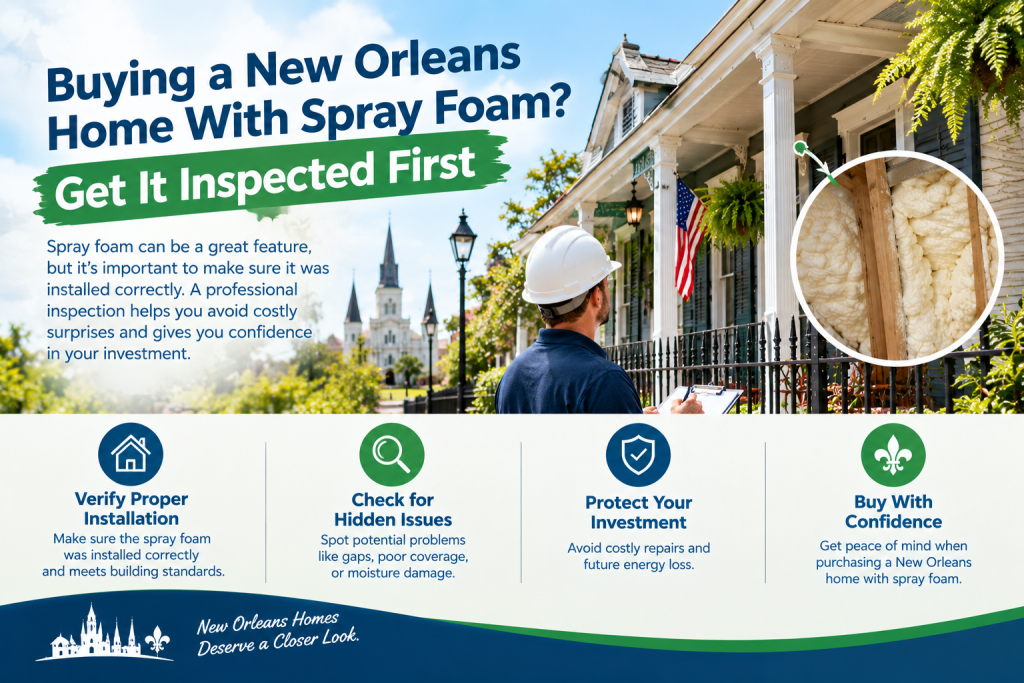
Spray foam in the attic of a house you are buying is usually good news. It is also the one upgrade that can quietly narrow what everybody else on your side of the transaction is able to see.
Foam is applied to surfaces. Once it is on, those surfaces are covered, and several of the inspections a Louisiana buyer relies on are defined around what remains visible and reachable. That is not a reason to avoid a house with foam in it. It is a reason to look at the foam deliberately, before the contingency period runs out.
The document to look for first, and where it should be
Louisiana gives you a head start that most buyers never use.
Under the Louisiana Energy Code 2021, a State of Louisiana Insulation Certificate shall be permanently posted in a utility area. The certificate template is set out in the code and it is unusually detailed for an energy code form. It records:
- the date installed and the permit number
- insulation details by area, including R-value, installed thickness, spray foam density and the thermal or ignition barrier used, for the attic roofline, attic floor, cathedral ceiling, exterior walls, knee walls, band joist, crawl space and basement walls
- the jobsite address and the general contractor license number
- the insulation contractor and installer
- the product manufacturer and product names
- a supplemental packet, which is meant to include safety data sheets, technical data sheets, applicator training certificates and blower door test results
Go and look in the utility room. If the certificate is there and filled in, you have the foam type, the density, the thickness, the installer, their license number and possibly a test result, all in one place, for free. If it is missing on a house built or substantially insulated under the current code, that absence is itself worth asking about.
What a standard home inspection will not tell you
A general home inspection is normally a visual, non-destructive survey, and what it covers is set by the standards of practice your inspector works to. Ask for those standards in writing rather than assuming. Whatever they say, a visual survey has physical limits on a foamed house:
- the inspector can see the face of the foam and not the substrate behind it
- thickness cannot be confirmed by looking at a surface
- coverage at top plates, around penetrations and in tight framing bays is hard to judge from the middle of an attic
- whether the foam is adhered or merely resting against the deck is not always visible
- the roof sheathing above the foam is no longer inspectable from inside at all
None of that makes the inspection worthless. It makes it incomplete on precisely the assembly you are asking about, which is why a foam-specific look is a separate piece of work.
The Louisiana wrinkle: your termite letter
This is the part that is genuinely local, and it catches people.
Louisiana’s structural pest control rules define a readily accessible area as an area that is unobstructed and able to be reached and entered for visible examination at the time of inspection. The definition explicitly excludes areas concealed by walls, ceilings, floor coverings, furniture, appliances, equipment or stored articles, and crawl spaces and attics that cannot be entered because the openings are too small or there is no permanent ladder or staircase or the area is undecked.
Termite control contracts in Louisiana must provide for at least one inspection of all unobstructed or accessible areas outside the structure before the agreement expires. Wood destroying insect report inspections, the “termite letter” that shows up in most local sales, are required to cover all unobstructed or accessible areas including bath traps with visible access, crawl spaces of raised pier construction, and attics with a permanent ladder or staircase.
Spray foam is a surface treatment applied to exactly the kind of framing those inspections look at: band joists, sill areas, the underside of roof decks, rim areas in a raised crawl space. Foam does not attract termites and Louisiana’s pest control rules say nothing about insulation. What foam can do is change what counts as visible.
So do not assume, in either direction. Do this instead:
- Give the pest control company the location and extent of the foam before the inspection.
- Ask in writing what remains accessible for inspection and what does not.
- Ask how the existing contract, if there is one, treats concealed areas, and whether the seller’s contract transfers.
- Read the contract terms rather than relying on a summary. Coverage, inspection obligations and any damage repair warranty are creatures of that contract.
Note one related detail worth knowing: for pre-construction or new construction termiticide treatment, Louisiana requires the contract to include a damage repair warranty of not less than $25,000, exclusive to the property owner for five years, subject to the contract’s terms and conditions. That is a rule about termiticide contracts rather than about insulation, and it is a useful thing to ask about on a newer house.
If the house is new construction
The Louisiana New Home Warranty Act sets out warranty periods that run from the warranty commencement date, which is the date legal title is conveyed to the initial purchaser or the date the home is occupied, whichever comes first:
- one year against defects due to noncompliance with the building standards or other defects in materials or workmanship
- two years on the plumbing, electrical, heating, cooling and ventilating systems, excluding appliances, fixtures and equipment
- five years against major structural defects
If you are the initial purchaser, find out where you sit in those periods before closing, and get the insulation certificate and any blower door result into your file while the builder is still easy to reach.
What a spray foam inspection actually looks at
A foam-specific inspection is a short, targeted job. The things worth checking are:
- Adhesion. Foam should be bonded to a clean, dry substrate. Sections that have pulled away from the deck or the framing are the single most useful thing to find.
- Shrinkage and gaps. Look at the edges, at top plates, around penetrations and at the transitions between lifts.
- Thickness and coverage. Depth should match what the certificate or the contract says, and it should be consistent rather than heavy in the middle of a bay and thin at the edges.
- Thermal or ignition barrier. Where the code requires one, it should be present and continuous, and the certificate should say what was used.
- Moisture evidence. Staining, rust on fasteners or nail plates, or a damp smell around the roof deck all warrant a closer look.
- Odour. A persistent chemical smell long after installation is a reason to ask questions rather than to assume.
- What happened to the attic. If foam went on the roof deck, the attic is now inside the envelope. That changes ventilation, duct location and how the space behaves.
- Ductwork. In climate zone 2A, which covers all of Louisiana for energy purposes, supply and return ductwork must not be buried in insulation.
- Whole-house ventilation. Where a blower door test was performed and the result came in under 3 air changes per hour, the dwelling must be provided with whole-house mechanical ventilation in accordance with Section M1507.3. On a tightly foamed house, ask whether that was designed in.
Our guide to the warning signs of a bad foam install in a humid climate goes through what each of those findings usually means.
Questions to put to the seller in writing
- Who installed the foam, when, and are they still trading?
- Which product, which type and what density?
- Is there a written warranty, and does it transfer to a new owner?
- Was a blower door test run, and can I have the result?
- Was the attic converted to unvented, and was ventilation addressed?
- Has the roof been replaced or repaired since the foam went in?
- Is there an active termite contract, and what does it say about concealed areas?
Where this sits in your timeline
Order the foam inspection early in the contingency period rather than at the end of it. If something comes back needing a closer look, you want the time to get it, and you want any remediation quoted before your inspection window closes rather than after.
If you want the assembly looked at by people who install it for a living, that is what spray foam inspections are for. If the finding turns into work, the relevant pages are insulation and attic insulation, and the material comparison is in open cell versus closed cell insulation.
Frequently asked questions
Does spray foam in the attic hurt a home’s resale value?
Properly installed foam is generally treated as an upgrade, because it improves comfort and reduces air leakage in a climate where both are expensive. What creates resale friction is undocumented foam: no certificate, no installer name, no product details and no test result. The paperwork is worth as much as the foam at resale, which is a good reason to collect it while you are buying rather than when you are selling.
Will my home inspector check the spray foam?
A general inspector will note that foam is present and describe what is visible. Home inspections are normally visual and non-destructive, and are not designed to verify thickness, adhesion or coverage behind a surface. Ask your inspector for the standards of practice they work to so you know what is included. If the foam matters to your decision, treat it as a separate specialist inspection in the same way you would treat a sewer scope or a structural engineer’s visit.
Can foam hide roof leaks?
Foam applied under a roof deck sits between you and the sheathing, so a leak can wet the deck without showing a stain on a ceiling below. That is one of the reasons the foam inspection looks for rust on fasteners, discolouration at the edges of the foam and any smell of damp. It is also a reason to ask about the roof’s age and history separately from the insulation.
Should I ask the seller to remove the foam?
Very rarely, and not on the strength of a general worry. Removal is disruptive and expensive, and most findings are localised: a section that has pulled away, a missing thermal barrier, thin coverage in a few bays. Get the specific finding and a quote to address it, then negotiate on that rather than on the principle.
Does foam affect my termite letter in Louisiana?
It can affect what the inspection is able to cover, because Louisiana’s definition of a readily accessible area excludes concealed areas, and wood destroying insect report inspections are required to cover unobstructed or accessible areas. Whether that matters in your particular house depends on where the foam is and what the contract says. Ask the pest control company in writing before the inspection, and read the contract rather than a summary of it.
Is there anything I should look for on a raised pier and beam house specifically?
Yes. Look at what is under the floor, not just in the attic. Research on Louisiana raised floor homes carried out by the USDA Forest Products Laboratory with the LSU AgCenter found that the permeability of the under-floor insulation, the permeability of the interior floor finish and the summer thermostat setting all affected subfloor moisture, and that open cell foam and fibreglass batts were not reliable for preventing summertime moisture accumulation in subfloors. Find out which material is down there and what the floor finish above it is.
Have the foam looked at before you close
Star Spray Foam is based in New Orleans at the address below. Ask whether your address is inside the working area when you call. If you are under contract and want the attic looked at properly, get in touch. Say who installed the foam and roughly when, ask whether an installation carried out by another company can be inspected, and ask what the inspection covers and what it produces.
Star Spray Foam
5826 Louis XIV St, New Orleans, LA 70124
504-229-6500
Sources
- Louisiana Energy Code 2021, Section R401.3 Certificate, Section R401.3.1 certificate template and Section R403.3.3 ducts, via UpCodes: https://up.codes/viewer/louisiana/iecc-2021/chapter/RE_4/re-residential-energy-efficiency
- Louisiana Residential Code 2021, Chapter 11 [RE] Energy Efficiency, via UpCodes: https://up.codes/viewer/louisiana/irc-2021/chapter/11/re-energy-efficiency
- Louisiana Administrative Code Title 7, Part XXV, Structural Pest Control, Sections 101 definitions, 119 contracts and 121 wood destroying insect reports, Louisiana Structural Pest Control Commission: https://www.law.cornell.edu/regulations/louisiana/La-Admin-Code-tit-7-SS-XXV-119
- Louisiana New Home Warranty Act, R.S. 9:3141 et seq., published by the Louisiana State Licensing Board for Contractors: https://lslbc.louisiana.gov/wp-content/uploads/New_Home_Warranty_Act.pdf
- LSU AgCenter Pub. 3187, Insulating Raised Floors in Hot, Humid Climates, with the USDA Forest Products Laboratory: https://www.lsuagcenter.com/nr/rdonlyres/d33f711d-dc4b-4e4c-9ed6-a97dce9db026/79805/pub3187insulatingraisedfloorslowres.pdf
- Building America Solution Center, Below Deck Spray Foam Insulation for Existing Roofs, Pacific Northwest National Laboratory: https://basc.pnnl.gov/resource-guides/below-deck-spray-foam-insulation-existing-roofs


