

Bad Spray Foam Install in a Humid Climate: The Louisiana Warning Signs
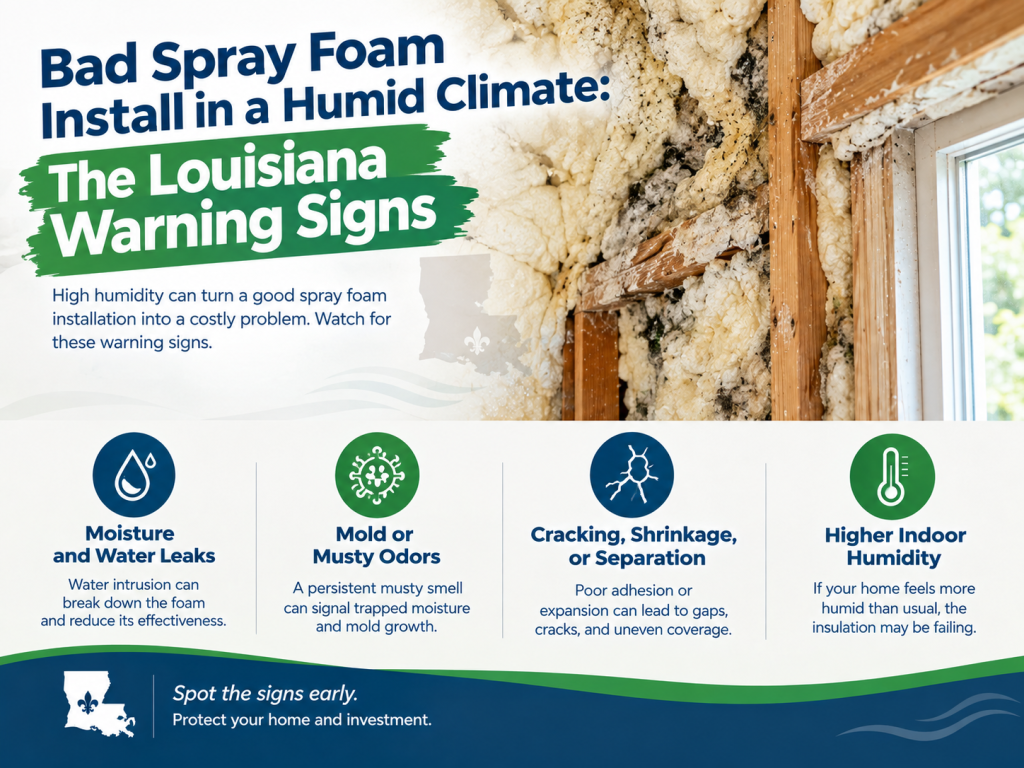
Most articles on bad spray foam are written as though the product arrives finished. It does not. As the Department of Energy’s Building US Solution Center puts it, spray polyurethane foam is a material that is essentially manufactured when it is applied at the building site.
That single fact explains why two crews using the same product can leave two very different results behind, and why the variables that decide the outcome are conditions on the day. The Solution Center lists them: moisture content and temperature of the substrate, the thickness of each applied layer or lift, the ratio of the two components during application, and the storage and handling of those components.
In a Gulf Coast summer, the first of those is not a theoretical concern. Here is what goes wrong and what each symptom usually points at.
1. Foam that has pulled away from the substrate
This is the most informative finding in the attic, because adhesion is the thing foam either did or did not achieve on the day.
The Spray Polyurethane Foam Alliance puts the standard plainly: foam should strongly adhere to nearly all construction materials that are clean, dry and free of oils and grease, and where the substrate is free of oil, dust, dirt and moisture and the product is applied per the manufacturer’s instructions, there should be no adhesion problems. The alliance also notes that foam may not adhere well to some materials, including polyethylene sheeting and under-cured concrete.
There is a simple field check for it. Adhesion should be checked occasionally by tearing a small area of foam away from the substrate. Where the foam is properly adhered, the foam itself should tear, leaving a thin but visible residue of foam behind on the substrate. Foam that lifts away cleanly did not bond.
Building Science Corporation documents one roof failure investigation that concluded the foam had been installed on wet oriented strand board, based on the poor adhesion and on a pore structure at the foam to board interface that indicated a wet substrate.
In this climate, sheathing that looks dry can still be carrying moisture. The Building US guidance is explicit about the remedy: monitor the moisture content of the roof sheathing during construction and take measurements before installing air-impermeable insulation, to help ensure the deck is dry enough to be covered.
What to do: photograph the debonded area, note its extent and where it sits, and get the assembly looked at before deciding anything. A small localised area and a whole slope are different problems.
2. Shrinkage, cracking or gaps opening at the edges
Foam that has pulled back from framing, or split along the line between two passes, usually points at how it was sprayed rather than at what it was.
The Spray Polyurethane Foam Alliance states that when improperly applied, some foams, particularly closed cell products, may shrink and pull away from structural members, and that improper equipment settings or excessive pass thicknesses can result in foam shrinkage. Isolated shrinkage can occur, and the number and size should not be extensive. Cracks and gaps caused by shrinkage can compromise the air sealing performance of the foam, and extensive shrinkage should be repaired.
The Department of Energy’s list of quality control issues points at the same variables: the thickness of each applied lift and the ratio of the two components during application. Each product carries a maximum lift thickness in its own technical data sheet, and exceeding it puts the work outside the manufacturer’s instructions.
What to look for: gaps at top plates, at the junction with the framing, and horizontal lines where one lift met the next.
3. Foam that is soft, crumbly, oily, brittle or smells strongly
The Spray Polyurethane Foam Alliance is direct about this set of symptoms. A mild odour for a short period after installation can be a temporary nuisance and supplementary ventilation of the work area for a few days is recommended to reduce it. Where other odours are present or persistent, or the foam is discoloured, inherently sticky or friable, those are symptoms of an improperly installed foam, and the alliance’s advice is to contact the contractor.
The U.S. Environmental Protection Agency adds the reason this is hard to time. Curing rates of spray polyurethane foam affect re-entry times, the curing time varies with the product, and more research is needed to account for the potential variability of curing rates. The agency also states that the potential for off-gassing of volatile chemicals from spray polyurethane foam is not fully understood. Its practical recommendation is that building occupants receive clear guidance from the contractor on safe re-entry times in advance of the work.
What to do: a persistent chemical smell long after installation is a reason to identify the product, retrieve its technical data sheet and get the installation assessed. Do not treat a lingering smell as something that will simply fade because someone said it would.
4. Uneven thickness and missed coverage
Thickness is what the R-value claim rests on, and coverage is what the air barrier rests on. Both are commonly imperfect in the places that are hardest to reach: the eaves, the ends of bays, behind bracing, around penetrations, and at the top plate line.
An air barrier with a hole in it performs like the hole, so a small missed area at a top plate can undo a great deal of otherwise good work. This is also why the blower door number after a foam job is worth having. It measures the result rather than the intention. Our guide to reading before and after test numbers covers how to compare them fairly.
5. No thermal or ignition barrier where one is required
Exposed foam generally needs a covering or coating in habitable and some non-habitable spaces. Louisiana’s insulation certificate form has a column for exactly this, recording the thermal or ignition barrier used for each area of the house. If the certificate is blank in that column, or the foam is bare where a barrier is required, that is a documentation and a compliance question for the installer and the local codes office.
6. Moisture evidence at the deck
Rust on nails and nail plates, dark staining at the edge of the foam, or a musty smell in a foamed attic all warrant a closer look. Wood moisture matters in specific, documented ways: the traditional guideline for protecting wood from rot or decay is to keep moisture content below 20 percent, mould growth can occur on wood above roughly 15 to 18 percent, and corrosion of metal fasteners in treated wood can occur above roughly 18 to 20 percent. Time spent at an elevated level is a key factor in each case.
Reaching those levels does not mean damage has occurred. It means the assembly deserves measurement rather than assumption.
7. The wrong material for the assembly, particularly under a raised floor
This one is specific to how houses are built here, and it is not strictly an installation defect. It is a specification decision that goes wrong often enough to belong on the list.
A year-long study of twelve Louisiana homes, eight in New Orleans and four in Baton Rouge, run by the USDA Forest Products Laboratory with the LSU AgCenter, monitored subfloor moisture under six different insulation systems. Eleven of the twelve houses were in flood hazard areas on open pier foundations.
The findings were consistent. Summertime subfloor moisture content rose as the indoor temperature fell, rose under less permeable floor finishes such as vinyl, and rose with more permeable under-floor insulation. Foil-faced rigid foam and closed cell spray foam performed well and kept subfloor moisture within acceptable levels. Open cell spray foam and fibreglass batts were not reliable for preventing summertime moisture accumulation in subfloors, and open cell foam gave readings above 20 percent moisture content in some cases where vinyl flooring was present and the air conditioning was set relatively low.
The study also found that houses holding summertime indoor temperatures of 78 degrees Fahrenheit or higher did not show elevated subfloor moisture, regardless of the insulation type.
What this means in practice: open cell foam under a raised floor, vinyl flooring above it and a cold thermostat is a combination with a documented moisture risk in this climate. If that describes your house, measure rather than worry. The difference between the two foam types is covered on our open cell versus closed cell page, and the raised floor assembly is covered under floor insulation.
8. Ducts buried in the insulation
In climate zone 2A, which is how all of Louisiana is designated for energy purposes, supply and return ductwork must not be buried in insulation. This is a state amendment, and it is one of the details a national installer working from a national playbook can get wrong.
9. Nothing was said about ventilation
Louisiana’s code provides that where a blower door test is performed and the air infiltration rate comes in under 3 air changes per hour, the dwelling must be provided with whole-house mechanical ventilation in accordance with Section M1507.3. Spray foam is capable of taking a house past that threshold.
If a house was foamed and nobody raised ventilation, that is a conversation worth having now rather than later. Our guide to Louisiana’s blower door code requirements covers who the rule applies to.
10. No paperwork at all
Louisiana requires a State of Louisiana Insulation Certificate to be permanently posted in a utility area on work under the current energy code. The template records installed date, permit number, R-value, installed thickness, foam density, thermal or ignition barrier, the general contractor license number, the insulation contractor and installer, the product manufacturer and names, and a supplemental packet containing safety data sheets, technical data sheets, applicator training certificates and blower door test results.
Missing documentation is not proof that anything was done badly. It does remove your ability to check, and it makes a warranty claim considerably harder.
What to do if you think your install went wrong
- Document before you touch anything. Photographs with something in frame for scale, and notes on where each one was taken.
- Find the certificate and the product name. The technical data sheet tells you the maximum lift thickness, the application temperature range and the required barrier.
- Get an independent look. Someone who did not do the work has no stake in the answer.
- Go back to the installer in writing. A written record of what you reported and when matters if the conversation gets difficult.
- Check the license and, if needed, complain. The Louisiana State Licensing Board for Contractors publishes a free contractor search and takes consumer complaints. Search on the exact legal entity name from your contract rather than the trading name on the vehicle, and read the status, the classifications and the expiration date off the result.
- Keep mould remediation separate. In Louisiana, mould remediation work valued at $7,500 or more requires a Mold Remediation license, and the qualifying party must hold twenty-four hours of training in mould remediation and basic mould assessment. That is a different license from an insulation contractor’s.
Frequently asked questions
Does spray foam cause mould in a humid climate?
Foam does not cause mould by existing. Mould needs moisture, and what matters is whether the assembly keeps the wood dry. Louisiana research on raised floors found closed cell foam and foil-faced rigid foam kept subfloor moisture within acceptable levels, while open cell foam and batts were not reliable in that position. The risk lives in the combination of material, assembly, floor finish and how cold the house is kept, rather than in the product on its own.
How long should spray foam smell after installation?
There is no single published figure that applies to every product, and the EPA says plainly that re-entry time depends on the formulation and on the factors affecting cure. What you should have is written guidance from the contractor on safe re-entry, given in advance. If a strong smell persists well beyond what the product’s own documentation describes, identify the product and get the installation assessed rather than waiting it out.
Can bad spray foam be repaired, or does it all have to come out?
Most findings are localised and are addressed by removing the affected section and reapplying to a properly prepared substrate. Full removal is disruptive and expensive and is reserved for situations where the problem is genuinely widespread. The way to find out which you have is measurement and inspection rather than a quote based on a photograph.
My foam looks fine from the attic hatch. Is that enough?
A view from the hatch tells you that foam is present. It does not tell you about coverage at the eaves, adhesion behind the face, thickness, or what is happening at the top plates, which is where the useful findings tend to be. If the foam matters to a purchase, a warranty claim or a comfort problem you are trying to solve, look properly.
Is a low price a sign the job will be done badly?
No. Price on its own is not evidence about workmanship, and a contractor may be cheaper for perfectly ordinary reasons. What is worth checking is specific and verifiable: the license and its classification, the product and its technical data sheet, the applicator’s training, the lift thickness they intend to apply, and whether a blower door test and an insulation certificate are included in the scope.
Who is responsible if the foam was installed by the previous owner’s contractor?
That depends on the warranty terms, whether it transfers, and what the contract says. Manufacturer warranties and installer warranties are separate documents with separate conditions, and neither necessarily follows the house. If you are buying, ask for both in writing during the contingency period. Our guide to inspecting foam before you buy covers what else to collect.
Get an independent look at the foam
Star Spray Foam is based in New Orleans at the address below. Ask whether your address is inside the working area when you call. If something does not look right, get in touch. Say what you are seeing and where, ask whether work carried out by another company can be inspected, and ask what you receive at the end of the visit.
Star Spray Foam
5826 Louis XIV St, New Orleans, LA 70124
504-229-6500
Sources
- Building America Solution Center, Below Deck Spray Foam Insulation for Existing Roofs, Pacific Northwest National Laboratory: https://basc.pnnl.gov/resource-guides/below-deck-spray-foam-insulation-existing-roofs
- Building Science Corporation, BA-1312: Application of Spray Foam Insulation Under Plywood and OSB Roof Sheathing: https://buildingscience.com/documents/bareports/ba-1312-application-of-spray-foam-insulation-under-plywood-and-osb-roof-sheathing/view
- U.S. Environmental Protection Agency, Spray Polyurethane Foam Insulation and How to Use it More Safely, archived Safer Choice guidance: https://archive.epa.gov/epa/saferchoice/spray-polyurethane-foam-spf-insulation-and-how-use-it-more-safely.html
- U.S. Environmental Protection Agency, Vacate and Safe Re-Entry Time for Spray Polyurethane Foam Application, archived Safer Choice guidance: https://archive.epa.gov/epa/saferchoice/vacate-and-safe-re-entry-time-spray-polyurethane-foam-application.html
- LSU AgCenter Pub. 3187, Insulating Raised Floors in Hot, Humid Climates, with the USDA Forest Products Laboratory: https://www.lsuagcenter.com/nr/rdonlyres/d33f711d-dc4b-4e4c-9ed6-a97dce9db026/79805/pub3187insulatingraisedfloorslowres.pdf
- Louisiana Energy Code 2021, Section R401.3 Certificate and Section R403.3.3 ducts, via UpCodes: https://up.codes/viewer/louisiana/iecc-2021/chapter/RE_4/re-residential-energy-efficiency
- Louisiana State Licensing Board for Contractors, Types of Licenses, including the Mold Remediation license threshold: https://lslbc.gov/types-of-licenses/
- Spray Polyurethane Foam Alliance, technical FAQs on adhesion, shrinkage and odour: https://www.sprayfoam.org/technical/faqs
- U.S. Environmental Protection Agency, Potential Chemical Exposures From Spray Polyurethane Foam, archived Safer Choice guidance: https://archive.epa.gov/epa/saferchoice/potential-chemical-exposures-spray-polyurethane-foam.html
- Spray Polyurethane Foam Alliance, technical documents library: https://www.sprayfoam.org/technical-documents/


